
Welcoming Darker Season: Lithuania’s Autumn Equinox Warmed by Fire in Vilnius
Stonehenge may be Britain’s best-known gathering point for marking seasonal traditions, but Lithuania has its own living autumn counterpart. In Vilnius and the nearby ancient capital Kernavė, fires, traditional songs and Baltic folklore lead into an autumn calendar that culminates in Vėlinės with its candlelit cemeteries.
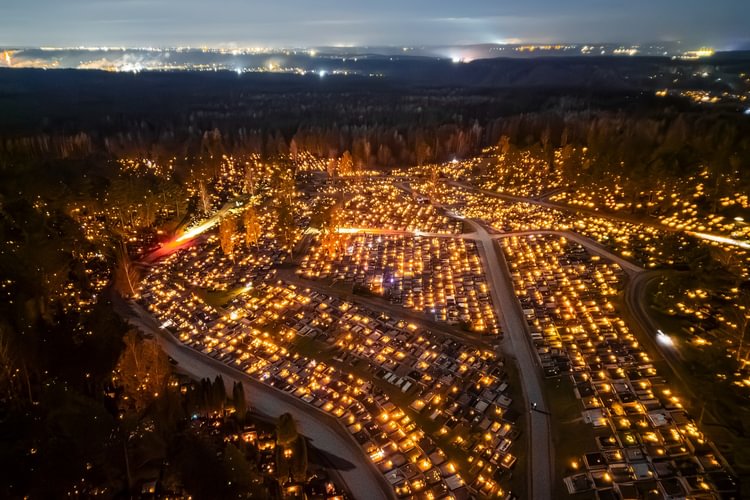
Lithuania, Europe’s last country to officially adopt Christianity in 1387, still marks the season’s shift from light to darkness with fire rituals, ancient songs, and harvest customs. Vilnius and the nearby ancient capital Kernavė offer special celebrations this September and November.
While Britain’s ancient landscapes like the Stonehenge are closely associated with solstice rituals, Lithuania, and its capital, offers a living counterpart at the turning point of the year.
This autumn, the astronomical autumn equinox is happening on the early morning of September 23, with celebrations happening on the evening of September 22 - and its traditions are rooted in Lithuania’s pre-Christian past.
The autumn equinox also falls within an ancient Baltic harvest season, when communities marked the end of agricultural work with feasts, offerings and rituals of gratitude to the gods. Today, these pre-Christian traditions are reinterpreted through fire, music and rituals.
“The modern celebration draws on rituals described in 16th and 17th-century sources, when people marked the beginning and end of harvest work with prayers and offerings of thanks to the old gods,” says Audronė Daraškevičienė, an educator at Lithuania’s National Museum.
“This was a time for bringing in the crops, gathering with the local community, and brewing beer, but also for returning from the fields to their homes, from the lively summer season towards a quieter, more inward period. Today’s equinox celebrations continue this connection with nature and the changing seasons, allowing us to prepare for the transition into the darker part of the year,” Daraškevičienė explains.
For the Balts, the autumn equinox also marked the beginning of the time of the dead and the preparation for Vėlinės (All Soul’s Day), a celebration when ancestors are remembered. It was and still is a time to give thanks both for the harvest and for the ancestors believed to help it grow, with both understood as coming from the earth.
“As the days grow shorter and light begins to give way to darkness, the rhythm of everyday life changes with the season. The equinox is a moment to stop and acknowledge that change, rather than simply letting the seasons pass us by. It allows us to experience that transformation together and to find warmth, and strength as the darker part of the year begins,” says Elena Mikniūtė, Communications Coordinator at Vilnius Ethnic Culture Centre.
One of the more unusual traditions associated with the autumn equinox is the creation and burning of large straw or reed sculptures. Made from natural materials gathered from the landscape, the sculptures are set alight as a symbolic farewell to the light half of the year and a welcome to the darker season. Other seasonal traditions include making compositions and sculptures from apples, nuts, pumpkins and grain, while the harvest is celebrated with foods including apple cheese, fresh bread, and pies.
Several annual events take place in and around Lithuania’s capital, including the ones this year:
Autumn Equinox and Baltic Unity Celebration (September 19). The UNESCO-listed archaeological site of Kernavė, around 35 km from Vilnius, will host an Autumn Equinox and Baltic Unity celebration among its five hillforts and the Pajauta Valley. As darkness falls, the evening will culminate in fires lit on the hillforts, accompanied by folklore, traditional rituals, night dancing and traditional songs, called sutartinės – Lithuania's ancient polyphonic chants recognized by UNESCO.
Baltic Unity Fire Call (September 22). The evening before the equinox, on September 22, the tradition stretches across the Baltic region. Between 8 and 9 pm, fires will be lit on hillforts, sacred hills and other sites connected with Baltic history in Lithuania and Latvia as part of the Baltic Unity Fire Call. The simultaneous flames symbolise unity between Baltic tribes, some of them extinct,separated by distance but connected by a shared heritage. This year’s event also commemorates the 790th anniversary of the Battle of the Sun, a 1236 medieval battle between the Livonian Brothers of the Sword and pagan troops of Samogitians and Semigallians, where the Baltic pagans swiftly defeated their enemies.
Autumn Equinox Celebration in Vilnius (September 22). In Vilnius itself, the equinox will be marked on Stalas Hill on September 22 with DURYS (Doors in English), a contemporary interpretation of the seasonal transition. Organized by the Vilnius Ethnic Culture Centre, the event will use illuminated sculptures, fire, dance, candle patterns and performance to symbolically close the door on the bright season and welcome the cooler, darker months.
Vėlinės (November 1). Later in autumn, Lithuania’s seasonal traditions continue with Vėlinės, when people remember their departed loved ones by visiting cemeteries and lighting candles on graves. As darkness falls, thousands of candles illuminate cemeteries across Vilnius and Lithuania, creating a quiet, striking atmosphere that has become one of the country’s most distinctive autumn sights.